Entrances in shopping centres, hotels, office buildings, hospitals, restaurants and some industrial facilities often remain open for extended periods or operate with frequent door cycles. While this makes the movement of people and goods more convenient, it also allows air to move continuously between indoor and outdoor spaces under the combined effects of temperature differences, pressure imbalances and wind.
During summer, conditioned indoor air can escape through the opening. In winter, indoor heat may be lost in the same way. Outdoor dust, odours and insects may also enter with the moving air.
At times of heavy foot traffic, temperature fluctuations and draughts around the entrance can become more noticeable. This may affect the comfort of people passing through and make conditions around the entrance more difficult to manage.
An air curtain is typically installed above the doorway and delivers a continuous jet of air vertically or at a slight angle across the opening, creating an aerodynamic barrier. It cannot separate indoor and outdoor spaces in the same way as a closed physical door. However, when correctly designed, selected and installed, it can help reduce the exchange of warm and cold air and support indoor climate control around the entrance.
Actual performance depends on whether the airflow covers the width and height of the doorway, as well as on discharge velocity, airflow direction, indoor-to-outdoor pressure differences and surrounding wind conditions.

Air Curtain Application at a Commercial Building Entrance
Air Curtain Performance Is About More Than “How Strong the Air Feels”
The performance of an air curtain should not be judged solely by its rated airflow or by how strong the air feels directly beneath the unit. More important considerations include whether the airflow remains continuous across the full outlet, whether the velocity distribution is reasonably uniform and whether the discharge jet can reach the lower part of the doorway.
If airflow is concentrated in the centre of the unit while the ends remain weak, air may still pass through the sides of the opening. Simply increasing fan speed is not always the right solution. It may increase draught discomfort and operating noise, while airflow striking the floor, door frame or nearby walls may produce recirculation and turbulence that disrupt the continuity of the air barrier.
For an air curtain, a reasonably uniform band of air distributed across the doorway is often more useful than a powerful jet concentrated in one area. The fan must provide airflow appropriate for the doorway, but the outlet grille, guide vanes, internal air path and installation angle also have a direct influence on overall performance.
Why Cross Flow Fans Are Well Suited to Wide Air Outlets
Cross flow fans, also known as tangential fans, generally use a long cylindrical impeller with blades arranged along the axis of rotation. Air enters through one side of the impeller, flows across its interior and passes through the blade region a second time before being discharged from the opposite side. This produces a broad airflow pattern along the length of the impeller.
The design is well suited to the long, slim housings commonly used for air curtains. A cross flow impeller can be installed within a relatively shallow unit while delivering airflow across a wide section of the doorway. Cross flow fans are also used in air-conditioning units, heating appliances and other equipment where installation depth is limited and broad airflow distribution is required.
However, cross flow fans are not the default choice for every air curtain. Their compact dimensions and wide discharge pattern can be a good fit for commercial entrances with moderate installation heights and limited crosswinds.
For taller doorways, locations with larger indoor-to-outdoor pressure differences or units with higher internal resistance, the fan arrangement should be assessed against the required airflow, pressure, discharge velocity and throw distance. In some cases, centrifugal fans or other configurations may be more suitable.
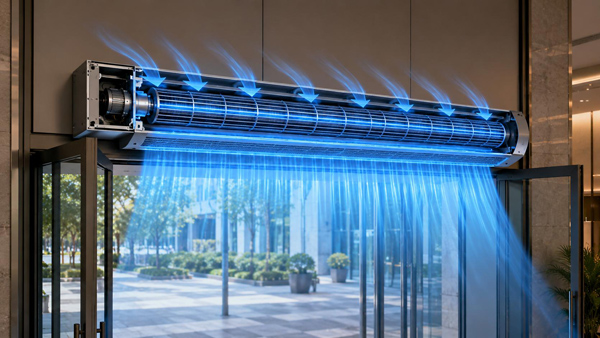
Airflow Organization of a Cross Flow Fan in an Air Curtain
The Complete Air Path Matters, Not Just the Fan
The fan is one of the components that generates the air curtain. Before the air leaves the unit, it may pass through the inlet, internal guide structures, heating components, outlet grille and adjustable vanes. Excessive resistance or poorly designed transitions at any point can affect both the delivered airflow and its distribution.
A cross flow fan should not simply be installed inside a housing without considering the surrounding geometry. The impeller length should match the effective outlet width, while the clearances between the impeller, cutoff and housing need to be carefully designed. The inlet area should also remain unobstructed by decorative panels, suspended ceilings or mounting structures.
If part of the inlet is restricted, the fan may still meet its catalogue specifications in isolation, yet the complete unit may produce uneven airflow at the ends, higher operating noise or a working point that differs from the intended design.
For heated air curtains equipped with electric heating elements or hot-water coils, airflow distribution through the heating section must also be considered. Insufficient or uneven airflow may affect component cooling and create variations in discharge-air temperature.
The fan, heating section, housing and internal air path should therefore be developed as an integrated system during product design.
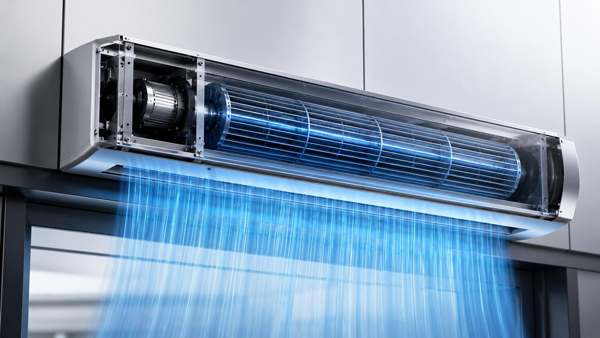
Internal Structure and Airflow Performance of an Air Curtain
Installation Conditions Determine Whether the Airflow Reaches the Lower Doorway
The effective discharge width of an air curtain should normally cover the full width of the doorway. Wider openings may require several units installed side by side, but attention should be paid to the areas where adjacent airflow streams meet, as gaps may reduce the continuity of the air barrier.
The position of the unit relative to the doorway also matters. If it is installed too far away from the opening, the jet may begin to spread before reaching the area where separation is required.
As doorway height increases, the airflow must remain coherent over a greater distance. This generally places higher demands on discharge velocity, direction and jet stability. Building orientation, indoor and outdoor temperature differences, door-opening frequency, crosswinds and negative pressure created by extract systems may also influence performance.
An air curtain can help manage air exchange through an open entrance, but it cannot correct every airflow or pressure problem within a building.
Cold stores, food-processing facilities and industrial passages may involve more demanding operating conditions, including condensation, dust, corrosive atmospheres and extended running hours. Fan and air curtain selection should therefore be based on actual site conditions, protection requirements and expected operating cycles rather than on a standard commercial configuration.

Air Curtain Application at an Industrial Passage and Loading Bay
Moving from Fixed Airflow to Demand-Based Control
An air curtain does not necessarily need to operate at the same speed at all times. Multi-speed or continuously variable control allows airflow to be adjusted according to operating hours, door position and changing environmental conditions, helping to avoid unnecessary high-speed operation.
Where the selected fan or motor supports PWM, 0–10 V or other control signals, it may be integrated with door switches, temperature controllers or equipment control systems. When the door is closed or traffic is light, the unit may reduce speed or stop according to the programmed control strategy. When the entrance opens, it can return to the required operating condition.
Variable-speed capability, however, does not automatically guarantee an effective air curtain. Airflow, operating sound and throw distance at different speeds should still be verified through prototype testing.
During product development, engineers should assess not only the catalogue performance of the fan but also its behaviour after installation in the complete unit. Airflow, sound levels, temperature rise and operating stability should be validated at the actual system working point.
Matching the Fan to the Requirements of the Entrance
For air curtains, air coolers and other equipment requiring wide airflow distribution, Blauberg can provide cross flow fan selection support based on housing design and operating conditions.
The selection process should take into account the effective outlet width, target airflow, system resistance, sound requirements, control method and installation environment, rather than relying only on rated power or maximum speed.
A continuous air curtain is created by several elements working together, from impeller geometry and motor drive to housing design and airflow control. The value of a cross flow fan lies in its ability to distribute air across a wide outlet within a slim, compact structure.
It cannot replace a physical door or eliminate all air exchange between indoor and outdoor spaces. In suitable applications, however, it can help establish a relatively continuous and stable aerodynamic boundary across an open entrance.