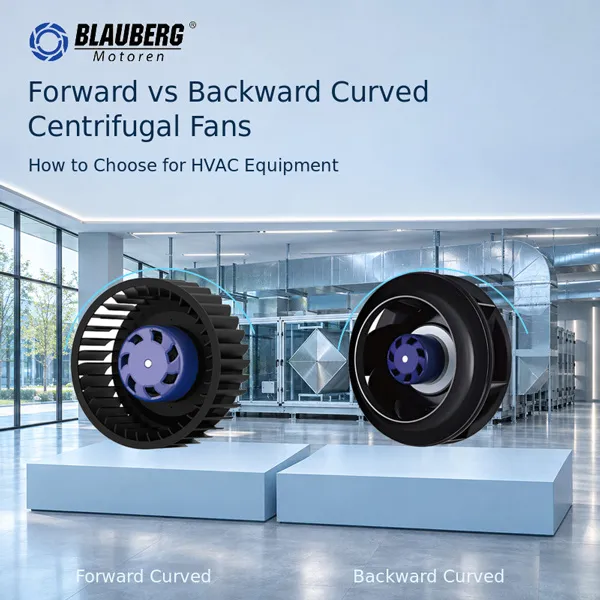
Choosing between a forward curved centrifugal fan and a backward curved centrifugal fan is an important step in ventilation equipment design. Both types move air through a centrifugal impeller, but their blade geometry and installation requirements influence how they should be integrated into the finished system.
For HVAC equipment manufacturers, the decision should start with the required airflow, pressure and available space. Comparing complete fan assemblies at the same operating point provides a more useful basis for selection than comparing impeller diameter alone.

What Is the Difference Between Forward and Backward Curved Fans?
The names describe the direction in which the impeller blades curve relative to rotation.
A forward curved centrifugal fan has blades that curve in the direction of rotation. This design commonly uses a wheel with numerous closely spaced blades and operates as part of a blower assembly with a scroll housing.
A backward curved centrifugal fan has blades that curve away from the direction of rotation. Depending on the product design, it may be supplied with a housing or configured for use in a plenum or plug-fan arrangement.
The distinction matters because the surrounding assembly forms part of the aerodynamic design. A motorized impeller should not be treated as a complete, interchangeable blower without checking how air enters and leaves it.
Consider the Housing Before Comparing Fan Size
A scroll housing collects air discharged by the impeller and directs it toward an outlet. Its geometry and relationship to the impeller affect the performance of the assembly.
For a forward curved centrifugal blower, selecting a compatible housing is therefore a central design consideration. If the impeller is supplied separately, the equipment manufacturer needs to confirm the intended housing arrangement with the supplier.
Backward curved fans also require installation-specific checks. A fan designed for a plenum needs suitable inlet conditions and discharge space. A backward curved impeller intended for a scroll housing should be evaluated in that configuration.
Before choosing either design, review the complete installation envelope, including inlet clearance, outlet connection, mounting points and service access.
Compare Performance at the Same Duty Point
A fair comparison requires both fan options to deliver the same airflow against the same pressure requirement.
Maximum airflow alone is insufficient. It does not establish the air volume available after filters, coils and ductwork add resistance to the system. Likewise, maximum pressure and maximum airflow should not be assumed to occur simultaneously.
Ask for performance data that allows comparison of:
· Airflow and pressure at the required duty point.
· Electrical input power at that point.
· Permitted operating range.
· Acoustic performance under comparable test conditions.
· Available speed adjustment and control interfaces.
This approach helps identify whether a particular centrifugal fan suits the application, regardless of its blade configuration.
EC Motor Technology Is a Separate Selection Choice
“Forward curved” and “backward curved” describe impeller geometry. “EC” describes motor technology. These terms answer different questions, and an EC centrifugal fan can use either impeller type.
Blauberg Motoren lists EC options within both its forward centrifugal fan range and backward centrifugal fan range.
When evaluating an EC model, confirm the supply requirements, supported control signals and wiring details for the exact product. Do not assume that every EC fan offers the same control functions.
The useful comparison is the performance of the complete motor-and-impeller assembly across the expected operating conditions. Motor technology alone does not establish which fan will consume less energy in a particular installation.
Avoid Choosing by Noise Claims Alone
Neither forward nor backward curved geometry guarantees the lowest noise in every application.
Noise depends on the operating point, rotational speed, impeller design and installation. An obstructed inlet or an unsuitable connection can also change the acoustic result inside the finished equipment.
When comparing published values, check whether they represent sound power or sound pressure. Also confirm the measurement conditions and operating point. Values measured under different conditions may not support a direct comparison.
Where noise is a key purchasing requirement, include an acoustic check in the finished-unit validation process.

Can One Fan Type Replace the Other?
Replacing a forward curved fan with a backward curved model, or vice versa, requires more than matching the mounting diameter.
A different fan may change the relationship between airflow and system resistance. It may also require changes to the housing, mounting arrangement, wiring or controller.
For a replacement project, provide the supplier with the existing fan model, assembly drawing, electrical supply and target performance. Where possible, include measured operating data rather than relying only on the original nameplate.
After installation, verify airflow, input current, noise and control response in the actual equipment.

Find the Right Centrifugal Fan for Your Project
The appropriate choice depends on how the fan works within the complete ventilation system. Housing compatibility, duty-point performance and electrical integration should be reviewed together.
For an initial selection, prepare the required airflow and pressure, available installation dimensions, supply voltage, control requirements and operating environment.
Explore Blauberg Motoren’s centrifugal fan ranges, or contact the team with your project requirements to request model-specific performance curves, dimensional drawings and electrical information.